When Fuel Prices Converge but Lives Do Not — by Hf Dauda MoiSoro
There was a time when Nigerians could take some comfort in the belief that, despite our many challenges, at least fuel remained relatively affordable compared to global prices. That illusion is now gone.
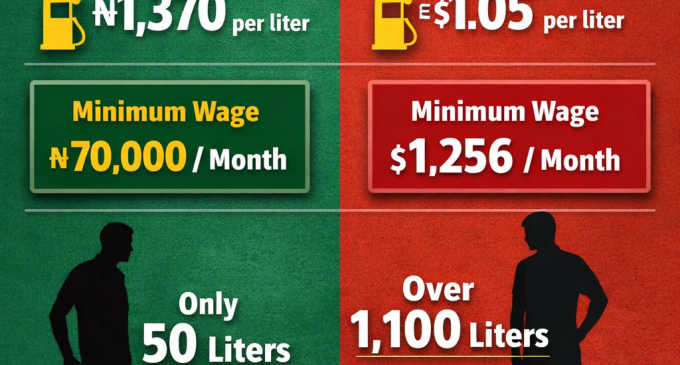
Today, a liter of fuel in Nigeria sells for about ₦1,370—roughly the same price per liter in the United States when converted to dollars.
At first glance, this may appear like a sign of “global alignment” or economic normalization. But that interpretation is dangerously misleading. Because while prices have converged, incomes have not.
In the United States, the federal minimum wage translates to roughly $1,256 per month.
In Nigeria, the newly approved minimum wage stands at ₦70,000 per month, signed into law by Bola Ahmed Tinubu.
Now consider this:
An American worker earning minimum wage can buy over 1,100 liters of fuel per month
A Nigerian worker earning minimum wage can barely afford 50 liters
* This is not just a gap.
* It is a collapse of economic dignity.
* Equal Prices, Unequal Pain
When two countries pay roughly the same price for fuel, but one earns 25 times more than the other, the burden is not equal—it is crushing.
Fuel is not a luxury. It is the backbone of:
• transportation
• food distribution
• electricity alternatives
• small businesses
In Nigeria, fuel price increases ripple through every aspect of life:
• Transport fares rise
• Food prices spike
• Inflation deepens
• Poverty expands
For millions, survival becomes a daily calculation.
The Policy Failure We Must Confront did not emerge overnight. It is the result of years—if not decades—of:
• weak economic planning
• currency mismanagement
• overdependence on imports
• failure to refine our own crude oil
Nigeria is an oil-producing nation that imports fuel at global prices, only to sell it to citizens earning local, depressed wages. This contradiction is not just economic—it is moral.
The Illusion of Reform: Some will argue that current policies are necessary reforms. That subsidies had to go. That the market must be allowed to function.
But reform without protection is not reform—it is abandonment.
A government must balance economic correction with social stability. When citizens are exposed to global prices without global incomes, the result is predictable:
• hardship
• anger
• instability
• What Must Change
Nigeria does not lack resources. It lacks alignment between:
• policy and people
• leadership and reality
We must:
Strengthen the naira through productive economic activity
• Invest in local refining capacity
• Support wages that reflect real living costs
• Prioritize citizens over abstract economic theories
Conclusion: A Question of Justice
The issue before us is simple:
If Nigerians must pay global prices,
why are they condemned to live on local poverty wages?
Until that question is answered—not with words, but with action—
the crisis will only deepen.
April 13, 2026